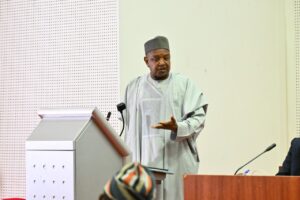
Minister of Budget and Economic Planning Senator Abubakar Bagudu has linked the debate over Nigeria’s national budget to the country’s broader ambition of building a $1 trillion economy.
Bagudu spoke at the Senate Press Corps Capacity-Building Workshop, where he called on journalists to help deepen public understanding of Nigeria’s fiscal position and the resources required to finance development.
The workshop focused on “Leveraging Legislative Oversight and Media Collaboration to Safeguard the National Budget from Unlawful Insertion.”
Bagudu said Nigeria must confront the reality of its limited fiscal space and consider how additional resources can be mobilised to support its growing population and development needs.
He questioned whether the country could continue operating with a relatively limited budget while simultaneously pursuing ambitious economic and development targets.
According to the minister, the question of what Nigeria’s budget should be cannot be separated from the country’s infrastructure requirements, social needs and long-term economic objectives.
He linked the discussion to President Bola Tinubu’s Renewed Hope Agenda and Agenda 2050.
Bagudu said the aspiration of building a $1 trillion economy would require Nigerians to have a serious conversation about revenue, expenditure and borrowing.
He urged the media to play an important role in this discussion by helping citizens understand the difficult choices involved in managing public resources.
The minister also stressed the importance of public confidence.
He said decisions on revenue mobilisation, spending and borrowing are more sustainable when citizens understand the reasons behind them.
Bagudu highlighted the constitutional responsibilities of the National Assembly in the budget process, urging the media to explain the relationship between the executive and legislature to the public.
He also addressed concerns about alleged unlawful budget insertions.
The minister advised journalists to investigate individual provisions thoroughly instead of assuming that every unfamiliar allocation is irregular.
He said reporters should establish where a provision originated, why it was included and who is expected to benefit.
Bagudu pointed to water infrastructure in underserved communities and equipment for fishing communities as examples of projects that could appear questionable without sufficient local information.

He maintained that this should not prevent journalists from scrutinising the budget.
Instead, he said, the media and legislative oversight institutions should remain vigilant because human errors can occur at different stages of the budget process.
The minister also cautioned against treating capital expenditure as automatically superior to recurrent expenditure.
He said expenditure on security, education, healthcare, human capital and public-sector workers could have direct developmental consequences.
Read Also: Lady alleges Reekado Banks’ management failed to honour promise
Bagudu further stressed the importance of meeting debt-service obligations.
According to him, failure to honour debt commitments could influence borrowing costs and create consequences for private-sector operators.
He called for a balanced approach to transparency, particularly in situations where releasing certain information could affect national security or strategic interests.
The minister urged journalists to continue holding government institutions accountable but warned against losing sight of Nigeria’s larger development challenges.
He said economic transformation would require a combination of government action, public support and innovative thinking.
Bagudu therefore encouraged the media to move beyond reporting isolated budget controversies and help Nigerians understand the larger economic choices facing the country.